Introduction
Maintaining consistent product quality is one of the biggest challenges for manufacturing businesses. From raw material inspection to finished product testing, every stage of production requires proper quality checks. Even a small defect can lead to product returns, production delays, increased costs, and customer dissatisfaction.
Managing these processes manually through spreadsheets, paper reports, or disconnected software can make it difficult to identify problems and maintain accurate quality records.
Odoo Quality Management helps manufacturers organize quality inspections, record defects, monitor production issues, and improve quality control through a centralized ERP system. By connecting quality processes with manufacturing and inventory operations, businesses can gain better visibility into product quality and make more informed decisions.
What Is Odoo Quality Management?
Odoo Quality Management is a set of tools within the Odoo ERP ecosystem that helps businesses manage product inspections, quality checks, and manufacturing quality processes.
It allows teams to define quality control points, perform inspections at relevant stages, record quality issues, and maintain information about products that do not meet established standards.
For manufacturers, quality management is not limited to checking the finished product. It can involve inspecting incoming materials, monitoring production operations, and verifying products before they are shipped to customers.
With an appropriate Odoo configuration, businesses can connect quality activities with their manufacturing and inventory workflows instead of managing quality information separately.
Learn more about Odoo ERP Development Services by Brainwings Infotech.
Why Is Quality Management Important for Manufacturing Businesses?
Manufacturing companies must meet customer expectations while controlling production costs and minimizing waste. A structured quality management process helps achieve these objectives.
1. Reduce Product Defects
Quality inspections help employees identify problems before defective products move to the next production stage. Detecting issues earlier can reduce rework, material waste, and unnecessary production expenses.
2. Maintain Consistent Product Standards
Manufacturers often produce the same product across multiple batches. Standardized quality checks help teams apply consistent acceptance criteria and identify variations that require attention.
3. Improve Production Visibility
When quality information is connected to production operations, managers can better understand where defects occur and which processes require improvement.
4. Improve Traceability
Accurate inspection records help businesses investigate quality problems by reviewing relevant products, production orders, batches, and recorded inspection results.
5. Support Better Business Decisions
Quality reports help managers identify recurring defects, evaluate rejection rates, and prioritize improvements based on recorded operational data.
Key Features of Odoo Quality Management
The available features depend on the Odoo version, installed applications, configuration, and any custom modules. Common quality management capabilities include the following.
1. Quality Control Points
Quality control points define when and how quality checks should take place. Manufacturers can configure checks around relevant operations, such as incoming material receipts, manufacturing processes, or outgoing deliveries.
For example, a plastic products manufacturer may require dimensional checks during production and a visual inspection before dispatch.
Defining suitable quality control points helps employees follow a consistent inspection process.
2. Quality Checks and Inspections
Quality checks help employees verify whether products meet predefined requirements. Depending on the operation and configuration, checks may involve measurements, visual inspections, pass/fail decisions, or other supported methods.
Examples include:
- Checking product dimensions and weight.
- Verifying material quality before production.
- Inspecting finished products for visible defects.
- Recording test results against defined specifications.
- Confirming packaging and labeling requirements.
These checks provide a structured way to capture inspection results and identify products that need further attention.
3. Quality Alerts
When an inspection identifies a problem, a quality alert can help the responsible team document and investigate the issue.
A quality alert may include the affected product, the relevant operation, a description of the defect, its severity, and the person responsible for follow-up.
For example, if a production batch contains incorrectly sized components, the quality team can record the issue and coordinate the investigation with manufacturing.
4. Quality Teams and Responsibilities
Clear responsibilities are essential for resolving quality problems. Quality workflows can help businesses assign ownership, communicate issues, and track the next steps.
Depending on the configured workflow, responsibilities may be shared among quality inspectors, production supervisors, warehouse employees, and quality managers.
5. Quality Reporting
Quality information becomes more useful when it can be analyzed over time. Businesses can review inspection outcomes, quality alerts, recurring problems, and other available records to identify improvement opportunities.
Additional dashboards or customized reports may be required when a business needs specific KPIs, department-level reporting, or advanced defect analysis.
How to Manage Quality Inspections in Odoo
A structured inspection process helps manufacturers identify issues consistently and respond before they affect customers.
Step 1: Define Quality Standards
Start by documenting the requirements each product must meet. These may include dimensions, material specifications, weight limits, surface finish, packaging requirements, or functional testing criteria.
Ensure that inspection standards are clear and measurable wherever possible.
Step 2: Configure Quality Control Points
Identify the production and inventory operations where inspections are necessary.
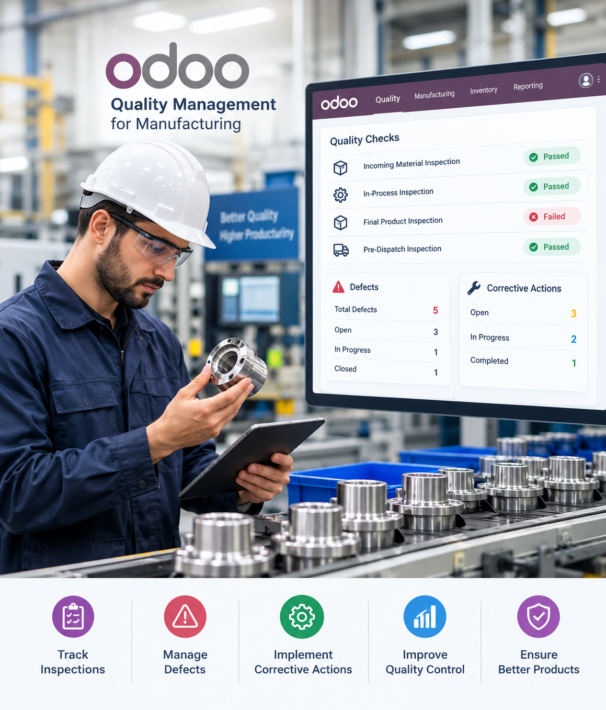
Common inspection stages include:
- Incoming raw material inspection.
- In-process manufacturing inspection.
- Final product inspection.
- Pre-dispatch quality verification.
Configure quality control points to match the relevant operations supported by your Odoo setup.
Step 3: Perform Quality Checks
Employees perform the required inspection when the relevant operation triggers a quality check. They record the result according to the configured inspection method.
If a product fails the inspection, the team should document the issue and follow the appropriate procedure for investigation or corrective action.
Step 4: Record and Investigate Defects
When defects are detected, record what happened, where the problem occurred, and which products or production orders may be affected.
A detailed record helps the quality team determine whether the issue resulted from incorrect material, machine settings, operator procedures, supplier quality, or another cause.
Step 5: Resolve the Issue and Verify the Result
After identifying the likely cause, assign the required action to the responsible person or team.
Depending on the issue, the response may involve rework, product segregation, process adjustments, supplier communication, or additional inspection.
Once the action is completed, verify whether the problem has been resolved and document the outcome.
How to Track Defects and Corrective Actions in Odoo
Identifying a defect is only the first step. Manufacturers also need a consistent method to investigate its cause, assign corrective actions, and confirm that the problem does not continue.
Odoo’s quality workflows can provide a foundation for documenting and managing quality issues. More advanced corrective and preventive action processes may require additional configuration, custom fields, automated activities, or a dedicated quality module.
Identify the Root Cause
Start by investigating why the defect occurred rather than addressing only its visible symptoms.
For example, repeated surface defects in a manufactured component may be linked to raw material quality, equipment conditions, tooling wear, or an inconsistent production procedure.
Document the evidence and the identified or suspected cause.
Assign Corrective Actions
Corrective actions should clearly state what must be done, who is responsible, and when the task should be completed.
Examples include recalibrating equipment, reviewing supplier materials, updating work instructions, or retraining employees.
Businesses can use suitable Odoo activities and configured workflows to improve ownership and follow-up.
Monitor Action Status
Managers need visibility into open issues, overdue tasks, and completed actions. Depending on the configuration, Odoo can support this process through quality records, activities, notifications, and customized reporting.
Practical Example: Odoo Quality Management in a Manufacturing Company
Consider a manufacturer producing plastic components for industrial customers.
During final inspection, the quality team discovers that some components do not meet the required dimensional specifications.
Without a structured system, the team might record the problem in a spreadsheet, inform production through email, and manually follow up on the correction.
With a suitable Odoo quality workflow, the company can organize the process as follows:
- Inspection: The employee records the failed quality check.
- Documentation: The defect is linked to the relevant product and operation, where supported by the configuration.
- Investigation: The production and quality teams examine the cause.
- Corrective action: The responsible team adjusts the process or equipment.
- Verification: Additional checks confirm whether the components meet the required specifications.
- Review: Managers examine the recorded results to identify recurring issues and improvement opportunities.
The exact degree of automation depends on the Odoo version, available modules, and the company’s configured workflows.
Benefits of Odoo Quality Management for Manufacturers
Implementing an effective quality workflow can provide several operational benefits.
Better Quality Control
Standardized checks help employees follow established inspection requirements throughout production.
Lower Rework and Waste
Early detection helps teams address problems before they affect larger production batches or reach customers.
Improved Accountability
Documented quality issues and assigned responsibilities make it easier to follow up on unresolved problems.
Better Traceability
Organized records help teams investigate defects and identify the operations associated with quality issues.
More Informed Decisions
Quality data can reveal recurring issues, process weaknesses, and areas where additional training or equipment improvements may be beneficial.
Stronger Customer Confidence
Consistent inspection procedures and effective problem resolution can help manufacturers deliver products that meet customer expectations.
Why Choose Brainwings Infotech for Odoo Development?
Brainwings Infotech provides Odoo development and ERP services to help businesses improve workflows, connect business operations, and adapt their systems to specific requirements.
Our approach focuses on understanding your business processes before recommending an implementation or customization strategy.
We can help your business with:
- Odoo ERP implementation and configuration.
- Custom Odoo module development.
- Manufacturing workflow customization.
- Business application integration.
- ERP support, maintenance, and improvements.
Whether you need to configure existing Odoo quality features or develop a specialized workflow for inspections and corrective actions, the right solution should match your operational requirements and future business goals.
Learn more about our Odoo Development Services in Ahmedabad or explore our Odoo ERP Development Services.
Final Thoughts
Odoo Quality Management helps manufacturing businesses improve product quality by organizing inspections, identifying defects, and managing follow-up actions. With better visibility into quality issues and production processes, businesses can reduce rework, minimize waste, and maintain consistent product standards.
By implementing the right Odoo configuration and custom workflows, manufacturers can build a more structured quality control process that supports operational efficiency and customer satisfaction.
Brainwings Infotech helps businesses implement and customize Odoo ERP solutions according to their manufacturing requirements. Contact our team to explore how Odoo Quality Management can improve your inspection processes and strengthen quality control across your operations.
Visit Brainwings Infotech to learn more about our Odoo Development Services.