Introduction
Service-based businesses often manage many activities at the same time. A team may need to handle customer leads, prepare quotations, assign employees, manage projects, track working hours, send invoices, follow payments, and provide customer support.
When these activities are handled using separate tools, spreadsheets, emails, and manual processes, it becomes difficult to keep information organized.
This is where Odoo ERP for service-based businesses can make a major difference.
Odoo brings different business operations into one connected platform.
What Is Odoo ERP for Service-Based Businesses?
Odoo ERP for service-based businesses is an ERP solution that helps companies manage their complete service workflow from one system.
Instead of using one application for CRM, another for project management, a spreadsheet for employee hours, and separate accounting software for invoicing, businesses can connect these processes through Odoo.
A typical service workflow can look like this:
Lead → Opportunity → Quotation → Project → Tasks → Timesheets → Invoice → Payment → Customer Support
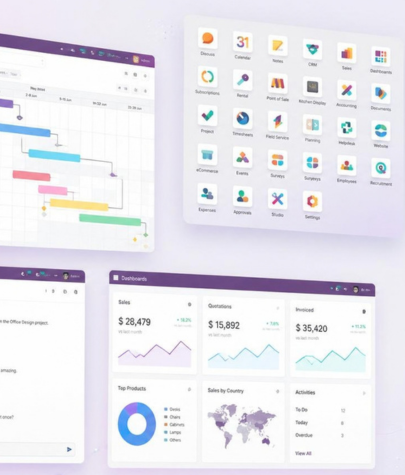
Odoo CRM can manage leads and opportunities, while Project can organize work into tasks and milestones. Timesheets can track employee working time, and invoicing can connect services delivered to customer billing. Odoo’s Project dashboard can also provide visibility into tasks, timesheets, planned hours, costs, revenues, milestones, and profitability for billable projects.
Why Do Service Businesses Need an ERP System?
Service companies sell knowledge, skills, time, and expertise rather than only physical products.
That creates different management challenges.
For example, a digital agency may need to know:
- Which projects are active?
- Which employee is working on each task?
- How many hours have been spent?
- Is the project profitable?
- Has the client been invoiced?
- Which invoices are unpaid?
- Which customer requests are still open?
A consulting company may need to manage employee schedules, billable hours, client communication, documents, contracts, and recurring services.
An IT services company may need CRM, support tickets, project delivery, timesheets, invoices, and technical resources.
Using multiple disconnected systems can make these processes harder to control.
Odoo helps connect these activities so businesses can work from shared information instead of maintaining the same data in multiple places.tely independently, organizations can establish common processes while maintaining company-specific data and rules.
How Odoo Automates Service Business Operations
1. Manage Leads and Customers with Odoo CRM
Customer management starts before a project begins.
Odoo CRM helps service businesses organize leads, opportunities, sales activities, and follow-ups. Leads can be assigned to salespeople or sales teams and converted into opportunities when they are qualified.
This makes it easier for sales teams to track the complete customer journey.
For example:
New Lead → Qualification → Opportunity → Proposal → Won Deal → Service Project
Instead of keeping customer information across emails and spreadsheets, teams can maintain a central customer record and connect sales information with later business activities.
2. Automate Project Management
Once a service is sold, the next step is delivery.
Odoo Project helps businesses break projects into tasks and manage work using a structured project workflow. Projects can include customers, project managers, planned dates, allocated hours, milestones, activities, documents, sales orders, invoices, and other related records.
For a software development company, a project could be divided into:
- Requirement Analysis
- UI/UX Design
- Development
- Testing
- Client Review
- Deployment
- Support
Project managers can monitor task progress and identify delayed or unfinished work.
Odoo also provides project dashboards with information about tasks, timesheets, planning, milestones, costs, revenues, and profitability.
3. Track Employee Time with Odoo Timesheets
For many service companies, time is the main billable resource.
Employees may work for several customers or projects during the same week. Without accurate tracking, it becomes difficult to understand where employee time is going.
Odoo Timesheets allows users to record working time against projects and tasks. Odoo documentation describes timesheets as a way to log, view, and validate working time across projects and employees, with integration into Project and Helpdesk.
Invoicing is a critical part of every service business.
4. Make Service Invoicing Easier
A company may offer services based on:
- Fixed-price projects
- Hourly billing
- Milestones
- Recurring services
- Retainers
- Expenses and reimbursable costs
Odoo supports different invoicing workflows. Customer invoices can be created from business documents such as sales orders, or created manually, followed by confirmation, sending, payment, reconciliation, and follow-up.
For a service-based company, this can reduce the need to manually calculate every invoice.
For example:
Sales Order → Project Delivery → Timesheet → Billable Hours → Invoice
This connected workflow can save administrative time and reduce billing mistakes.
5. Connect Timesheets with Project Profitability
Knowing revenue is not enough.
A service company also needs to understand whether a project is actually profitable.
Odoo’s project profitability functionality can compare project revenues and costs. The profitability information can include timesheets, materials, customer invoices, subscriptions, expenses, purchase orders, vendor bills, and other costs associated with the project.
This gives managers a clearer picture of project performance.
For example:
Project Revenue: ₹5,00,000
Employee Cost: ₹2,20,000
Other Costs: ₹80,000
Estimated Profit: ₹2,00,000
These figures can help management identify projects that are performing well and projects that require better cost control.
6. Improve Customer Support
Customer management does not end after the sale.
Service businesses need to respond to questions, complaints, support requests, and service issues.
Odoo Helpdesk allows customers to contact support teams through channels such as email, live chat, and website forms. These requests can be managed centrally as support tickets.
Odoo also provides Help Center capabilities that can combine Helpdesk with Knowledge, eLearning, and Forums so customers can find useful information about products and services.
This can help service businesses provide a more organized customer experience.
7. Manage After-Sales Services
Some service businesses need more than simple ticket management.
Odoo Helpdesk can connect after-sales workflows with functions such as refunds, returns, repairs, and Field Service interventions.
This can be useful for businesses providing:
- Equipment servicing
- Maintenance
- Technical support
- On-site services
- Repairs
- Installation
- Customer assistance
Instead of handling these processes manually, businesses can create connected workflows inside Odoo.
Key Benefits of Odoo ERP for Service Businesses
Better Project Visibility
Managers can see tasks, deadlines, allocated hours, timesheets, milestones, and project performance in a connected environment.
Accurate Time Tracking
Employees can record working time against projects and tasks, helping companies understand resource utilization and billable work.
Faster Invoicing
Connecting service delivery, sales, timesheets, and accounting can reduce manual invoice preparation.
Improved Customer Management
CRM and Helpdesk processes can keep customer interactions more organized from first enquiry through post-sales support.
Better Project Profitability
Businesses can compare project revenue and costs to understand which projects are profitable.
Less Manual Work
Automation reduces repeated data entry and helps employees spend more time on valuable business activities.
One Centralized System
Instead of depending on many disconnected tools, businesses can bring major operations together in Odoo.
Odoo Customization for Service-Based Businesses
Standard Odoo functionality may cover many business requirements, but every company has its own processes.
A service company may require:
- Custom approval workflows
- Custom quotation formats
- Industry-specific reports
- Special billing rules
- Employee dashboards
- Customer portals
- Custom project stages
- Automated email notifications
- Third-party integrations
- Custom CRM fields
- Custom timesheet rules
This is where Odoo ERP customization becomes valuable.
Brainwings Infotech provides Odoo customization services designed to adapt Odoo to a business’s specific processes. Its published service information highlights customized screens, workflows, features, and business-specific adjustments.
Instead of forcing your business to work around software limitations, customization can make the ERP system fit the business.
How Brainwings Infotech Helps Service Businesses with Odoo
Implementing an ERP system can be challenging when your company has unique workflows, custom requirements, or third-party integrations.
Brainwings Infotech provides Odoo services for businesses that need help with development, customization, integration, consulting, migration, and ongoing support.
Our Odoo services can help service-based businesses with:
- Odoo ERP development
- Odoo implementation
- Odoo customization
- Odoo integration
- Odoo migration
- Odoo consulting
- Odoo support and maintenance
- Custom workflows and business automation
- Odoo website development
- Custom Odoo modules
The goal is to create an Odoo ERP environment that is simple to use, connected, scalable, and aligned with the company’s actual business processes.
Final Thoughts
For a service-based business, managing time, people, projects, customers, and invoices efficiently is essential.
Odoo ERP for service-based businesses brings these important processes into one connected business platform. With Project, Timesheets, CRM, Invoicing, Accounting, Helpdesk, and other Odoo applications, companies can create smoother workflows from the first customer enquiry to final payment and ongoing support.
The biggest advantage is not simply having more software. It is having the right processes connected together.
With proper implementation and customization, Odoo can help service businesses reduce manual work, improve project visibility, track billable time, simplify invoicing, strengthen customer management, and make better business decisions.
For businesses looking for an Odoo Development Company in Ahmedabad, Odoo ERP customization, or Odoo integration services, Brainwings Infotech can help design and implement an Odoo solution based on your business requirements.