Introduction
Application Programming Interfaces (APIs) play an essential role in modern web applications, mobile apps, e-commerce platforms, and enterprise software. They allow different systems to exchange information, process requests, and connect business applications efficiently.
However, APIs also introduce security risks when authentication, access controls, data validation, and server configuration are not implemented correctly. An insecure API can expose customer information, allow unauthorized transactions, or provide attackers with access to sensitive business operations.
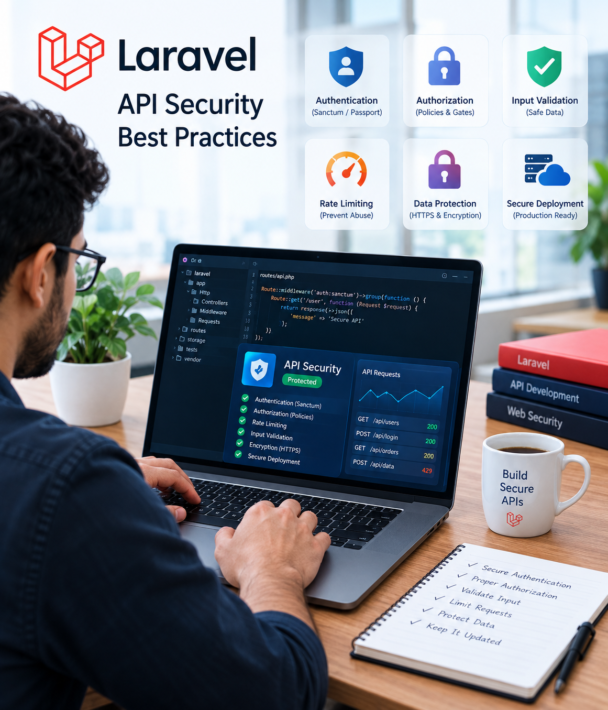
Laravel API security best practices help developers build reliable applications by combining Laravel’s security features with appropriate development standards and regular testing.
Why Is API Security Important in Laravel Applications?
Laravel APIs frequently handle sensitive information such as customer profiles, employee records, payment information, order details, and internal business data.
When an API is poorly protected, attackers may exploit weaknesses to access information, manipulate records, or consume excessive server resources.
Common API security risks include:
- Unauthorized users accessing private resources.
- Compromised authentication tokens being reused.
- Excessive data exposure through API responses.
- Unvalidated input reaching application logic or databases.
- Automated requests overwhelming application resources.
- Insecure third-party integrations exposing internal systems.
- Development settings or secrets accidentally exposed in production.
The OWASP API Security Top 10 identifies risks such as broken object-level authorization, broken authentication, unrestricted resource consumption, security misconfiguration, and unsafe consumption of other APIs. These risks provide a useful foundation for reviewing Laravel applications.
OWASP API Security Top 10
A secure API should protect not only the server but also the data and business operations that the API makes available.
1. Implement Secure API Authentication
Authentication verifies the identity of a user or application attempting to access an API. Protected endpoints should use an authentication mechanism appropriate to their intended users and business requirements.
Laravel supports different authentication approaches, including Laravel Sanctum and Laravel Passport.
Laravel Sanctum is suitable for many first-party applications, mobile applications, and APIs requiring straightforward token authentication. Laravel Passport provides OAuth 2.0 capabilities for applications that require more advanced authorization workflows.
The correct solution depends on the application architecture and integration requirements.
Recommended authentication practices include:
- Use established authentication tools instead of building an unnecessary custom authentication system.
- Protect private endpoints with the appropriate authentication middleware.
- Store access tokens securely and prevent their exposure in logs or URLs.
- Revoke compromised or unnecessary tokens.
- Establish suitable token expiration and rotation policies.
- Apply stronger authentication requirements to sensitive administrative operations.
A secure authentication system helps ensure that only approved users and applications can access protected API functionality.
2. Enforce Authorization and Access Control
Authentication alone does not guarantee that a user is permitted to access every resource within an application.
Authorization determines which records, features, and operations an authenticated user is allowed to access.
For example, in an e-commerce application, a customer should only be able to view their own orders. Logging in should not automatically grant access to another customer’s order history.
Laravel provides authorization features, including policies and gates, to help developers manage access permissions.
Businesses should ensure that authorization checks apply to individual records and sensitive operations, not just entire application sections.
Important considerations include:
- Restrict access to records according to ownership and user roles.
- Protect administrative functions from unauthorized users.
- Apply permissions consistently across all API endpoints.
- Prevent users from modifying fields they are not authorized to change.
- Review permissions whenever new roles or features are introduced.
Proper authorization helps prevent data exposure, unauthorized changes, and misuse of business functionality.
3. Validate All Incoming API Requests
Request validation is an essential part of secure API development. It ensures submitted information meets the application’s expected formats, limits, and business rules.
Without adequate validation, unexpected values may create inconsistent records, trigger application errors, or introduce security vulnerabilities.
Laravel provides built-in validation functionality that helps developers verify request data before processing it.
A robust validation strategy should cover required fields, accepted data types, maximum lengths, file sizes, supported formats, and business-specific conditions.
Developers should also:
- Reject invalid or unexpected input.
- Validate nested data and uploaded files.
- Restrict fields to approved values wherever possible.
- Use validated data during database operations.
- Apply suitable validation to search filters and sorting options.
- Return clear error messages without exposing internal application details.
Validation should be consistent across public endpoints, authenticated operations, and integrations with external systems.
4. Prevent Mass Assignment and Excessive Data Exposure
APIs often receive requests that create or update customer profiles, orders, employee records, and other business data.
A potential vulnerability occurs when an application accepts fields that users should not be permitted to modify. For example, a customer profile update should not allow users to assign themselves an administrator role.
Developers must carefully control which attributes can be updated through user requests.
Another concern is excessive data exposure. Returning complete database records when only a few fields are required can reveal unnecessary or confidential information.
Laravel API Resources help developers control how application data is presented in API responses.
Recommended practices include:
- Allow updates only to approved fields.
- Avoid accepting unrestricted user-submitted data.
- Exclude passwords, internal credentials, and confidential attributes from responses.
- Return only the information required by the application.
- Apply field-level permissions when different users require different information.
- Review nested relationships and associated records for unintended exposure.
Controlling both input fields and output data strengthens API security while making application behavior easier to maintain.
5. Apply API Rate Limiting
Rate limiting restricts the number of requests a user or client can make within a defined period.
Without appropriate limits, automated traffic can overwhelm an application, abuse authentication endpoints, trigger excessive messages, or increase the cost of third-party services.
Laravel provides rate-limiting capabilities that can be applied to incoming requests and other application operations.
Different endpoints may require different restrictions depending on their purpose and risk.
For example, login and password-reset endpoints require protection against repeated attempts, while data export and reporting endpoints may need limits because they consume significant resources.
Businesses should consider rate limiting for:
- Authentication and password-reset requests.
- Public enquiry and registration forms.
- Search and filtering operations.
- File uploads and data exports.
- Payment-related operations.
- Expensive API integrations.
Rate limits should account for relevant user identities, request patterns, business requirements, and expected traffic. They should also be monitored and adjusted as application usage changes.
Rate limiting does not replace authentication or authorization, but it provides an additional layer of protection against abuse.
Why Choose Brainwings Infotech for Laravel API Development?
Developing a secure API requires more than connecting different applications. It requires careful planning, appropriate access controls, reliable integrations, thorough testing, and ongoing maintenance.
Brainwings Infotech provides Laravel development services for businesses that need custom web applications, API integrations, and scalable digital solutions.
Our services include custom Laravel application development, API development, third-party integrations, application enhancements, migration, and ongoing support.
We focus on understanding business requirements and creating solutions that balance functionality, security, maintainability, and performance.
Whether your business is developing a new API or improving an existing application, the right development approach can help establish a dependable foundation for future growth.
Learn more about our Laravel Development Services to explore solutions for your business needs.
Final Thoughts
Laravel API security is an essential part of building reliable and scalable business applications in 2026. Although Laravel provides useful tools for authentication, authorization, validation, and rate limiting, effective protection depends on how these features are configured and used.
By enforcing access permissions, limiting unnecessary data exposure, protecting credentials, validating requests, securing integrations, and maintaining updated dependencies, businesses can reduce common API security risks.
A proactive approach to security supports customer trust, protects sensitive information, and helps applications remain dependable as business requirements evolve.
Brainwings Infotech helps businesses develop and maintain Laravel applications tailored to their operational requirements. With appropriate security planning and ongoing maintenance, your API can provide a strong foundation for your digital products and business processes.