Introduction
Artificial Intelligence is transforming how businesses communicate with customers, manage information, and make decisions. However, traditional AI applications can face an important limitation: they may not have access to a company’s latest internal information, private documents, customer records, or business-specific knowledge.
This is where Retrieval-Augmented Generation (RAG) becomes valuable.
RAG development combines information retrieval technology with Large Language Models (LLMs) to create AI applications that can search relevant business information before generating a response. Instead of depending entirely on the knowledge learned during model training, a RAG-powered application can retrieve information from approved company data sources and use that information to answer questions.
What Is Retrieval-Augmented Generation (RAG)?
Retrieval-Augmented Generation, commonly known as RAG, is an AI architecture that connects a Large Language Model with an external knowledge source.
A traditional AI chatbot generally generates answers using its existing model knowledge and the conversation context. However, a RAG-based application first searches a connected knowledge base to find relevant information. It then provides the retrieved information to the language model, which uses it to generate a context-aware response.
For example, consider a company that has hundreds of documents containing product specifications, company policies, technical manuals, and customer service guidelines.
Instead of asking employees to search through these documents manually, the company can implement a RAG-powered assistant. Employees can ask questions in natural language and receive answers based on the relevant company documents.
The core idea is simple:
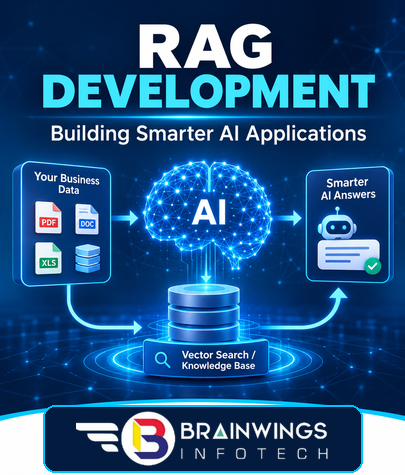
Business Data + Intelligent Retrieval + Large Language Model = Context-Aware AI Application
RAG is particularly useful when applications need access to private, specialized, or frequently updated information.
How Does RAG Development Work?
A RAG application follows a structured process that connects business data with an AI model. The quality of each stage influences the relevance and reliability of the final response.
1. Business Data Collection
The first step is identifying the information that the AI application needs to access.
Depending on business requirements, data sources may include:
- PDF documents and Word files
- Company websites and knowledge bases
- Product catalogues and technical documentation
- Customer support conversations
- Internal databases and business applications
- Company policies and employee documentation
- CRM and ERP information
The data must be collected from authorized sources and prepared for processing.
2. Data Processing and Document Chunking
Business documents can contain hundreds of pages of information. Sending complete documents to an AI model for every query is often inefficient.
RAG systems divide larger documents into smaller sections called chunks. These chunks retain useful context and can be retrieved individually when a user asks a question.
The chunking strategy depends on the type of information being processed. For example, product specifications, legal documents, technical manuals, and customer support articles may require different processing approaches.
Proper document processing helps the system identify relevant information more effectively.
3. Creating Embeddings
After processing, the text chunks are converted into numerical representations known as embeddings.
Embeddings help the system understand the semantic meaning of information rather than depending only on exact keyword matches.
For example, a user may search for:
“How can I return a purchased product?”
The knowledge base might contain information under the heading “Product Return Policy.”
Semantic retrieval can help identify the relevant information even when the user’s wording differs from the original document.
4. Storing Information in a Searchable Knowledge Base
The embeddings and associated document information are stored in a searchable index or vector database.
This allows the application to identify information that is semantically related to a user’s question.
Depending on the requirements, the architecture may use vector search, keyword search, or hybrid search that combines both approaches.
Modern RAG systems can also use semantic ranking and reranking techniques to improve the relevance of retrieved information.
5. Retrieving Relevant Information
When a user submits a question, the RAG application processes the query and searches the connected knowledge base.
The retrieval system identifies the most relevant document sections and selects the information needed to answer the question.
For more complex questions, the system may also rewrite the query, break it into smaller searches, or retrieve information from multiple data sources.
6. Generating an AI Response
Once relevant information is retrieved, the application provides it to the Large Language Model along with the user’s question and appropriate instructions.
The model then generates a response based on the supplied context.
Depending on the application, the response may also include source references, document titles, or links that help users verify the information.
7. Monitoring and Updating the Knowledge Base
A RAG application requires ongoing maintenance.
When business policies, product information, or company documents change, the knowledge base must be updated. An effective ingestion process should detect changes, update affected records, and remove information that is no longer authorized or relevant.
Regular testing and monitoring also help identify retrieval errors and improve response quality over time.
How Can RAG Development Benefit Businesses?
RAG development offers several practical advantages for organizations that manage large amounts of business information.
1. More Relevant AI-Generated Responses
RAG applications can use business-specific information when answering questions. This helps make responses more relevant to the organization’s products, services, policies, and processes.
2. Better Access to Company Knowledge
Employees often spend considerable time searching through documents, emails, and internal platforms.
An AI-powered knowledge assistant can make approved information easier to find through natural language questions.
3. Improved Customer Support
RAG-powered customer support applications can retrieve product documentation, service information, troubleshooting instructions, and approved support policies.
This can help customers find answers more quickly while allowing support teams to focus on complex issues.
4. Access to Updated Information
Traditional LLM knowledge is based on training data and the context provided during a conversation.
RAG allows applications to retrieve updated information from connected sources without requiring the underlying model to be retrained every time a document changes.
5. More Efficient Information Management
By connecting multiple approved information sources, businesses can make their knowledge easier to search and use.
This can reduce repetitive manual searches and support more efficient business operations.
6. Flexible Integration with Business Applications
RAG functionality can be integrated into websites, mobile applications, internal portals, customer support platforms, and enterprise software.
This allows organizations to introduce AI-powered information access into their existing digital environments.
Practical Business Use Cases of RAG Applications
RAG is not limited to chatbots. Businesses across different industries can use it to create applications that retrieve and interpret specialized information.
1. AI-Powered Customer Support Assistants
Customer support teams manage product questions, service requests, troubleshooting instructions, and company policies.
A RAG-based support assistant can retrieve relevant answers from approved knowledge resources and respond to customer queries.
For example, an e-commerce customer can ask about return policies, delivery procedures, product availability, or warranty conditions.
2. Internal Knowledge Management Systems
Large organizations maintain information across multiple departments and platforms.
Employees may need to search HR policies, project documents, technical guidelines, operational procedures, and training materials.
A RAG-powered internal assistant can provide a centralized way to search authorized company knowledge.
3. E-Commerce Product Information Assistants
Online stores manage extensive product catalogues containing descriptions, specifications, compatibility details, and purchasing information.
RAG applications can retrieve relevant product information and help customers discover suitable products through natural language questions.
This can create a more informative shopping experience.
4. Document Search and Analysis Applications
Businesses regularly work with contracts, reports, manuals, invoices, policy documents, and technical files.
RAG can help users locate relevant information across these documents without manually reviewing every file.
For sensitive contracts or financial documents, permissions and human review should be included in the application design.
5. ERP and Business Information Assistants
Companies often depend on ERP platforms to manage sales, inventory, purchasing, accounting, and other operations.
A RAG-based assistant can be designed to retrieve authorized business information from connected systems.
For instance, employees could ask questions about approved product documentation or internal process guidelines.
Live transactional information, such as current stock or order status, may require secure API or database access rather than document retrieval alone.
6. Technical Documentation Assistants
Software companies and IT teams maintain API documentation, development guidelines, configuration manuals, and troubleshooting resources.
An AI-powered documentation assistant can retrieve relevant technical content and help developers find information more efficiently.
RAG vs Fine-Tuning: Which Approach Should Businesses Choose?
RAG and fine-tuning are two different approaches to improving AI applications. They solve different problems and can also be used together.
RAG Development
RAG is suitable when an AI application needs access to private, specialized, or frequently changing information.
For example, a company that regularly updates its product documentation can connect those documents to a RAG system rather than retraining an AI model every time the information changes.
Model Fine-Tuning
Fine-tuning modifies a model using a carefully prepared training dataset. It may be useful when businesses need to adapt a model’s response patterns, specialized behaviour, or task performance.
Combining RAG and Fine-Tuning
Some advanced applications benefit from both approaches. Fine-tuning can help adapt the model’s behaviour, while RAG provides access to current business information.
The right choice depends on the business objective, available data, technical requirements, budget, and maintenance expectations.
Important Considerations When Building a RAG Application
Developing a reliable RAG application requires more than connecting a chatbot to a vector database. Businesses should consider the following factors before implementation.
Data Quality and Preparation
Poor-quality, duplicate, outdated, or incomplete documents can affect retrieval results. Organizations should establish a process for cleaning, organizing, and validating their source data.
Search Accuracy and Retrieval Quality
The application must retrieve information that actually answers the user’s question. Hybrid search, semantic ranking, query improvement, and reranking can be used where appropriate.
Data Privacy and Access Control
Enterprise applications may contain confidential information belonging to different departments, employees, customers, or business clients.
Access permissions must be enforced before documents reach the AI model. Permissions should also be preserved at the retrieved chunk level, particularly in multi-user and multi-tenant systems.
AI Security and Prompt Injection
Retrieved documents and user inputs should be treated as potentially untrusted content.
A malicious instruction hidden inside an uploaded document could influence an AI model if the system is not properly protected. Input validation, document screening, clear trust boundaries, output controls, and security testing are important parts of a production-ready RAG application.
Response Quality and Evaluation
A RAG system should be tested using realistic questions and expected results.
Evaluation should cover retrieval relevance, answer groundedness, completeness, response quality, and safety. Testing only whether the application produces a response is not sufficient.
Performance and Scalability
As the volume of documents and users increases, search performance and infrastructure requirements can change.
Businesses should consider response time, indexing costs, model usage, caching, database capacity, and expected user traffic during the planning stage.
How Brainwings Infotech Can Help Build Smarter Business Applications
Building an AI-powered application requires the right combination of backend development, data processing, application integration, and user experience.
Brainwings Infotech provides technology development services that can support businesses planning customized digital and AI-powered solutions.
Relevant capabilities include:
1. Python Development Services
Python is widely used in AI systems, data processing, automation, and backend application development. Brainwings Infotech provides custom Python development for business applications, data tools, and AI-related solutions.
Explore: Python Development Services
2. Custom Web Application Development
A RAG-powered knowledge assistant can be integrated into a business website, employee portal, or web-based application. Custom backend development helps connect the user interface with data sources and AI services.
Explore: Laravel Development Services
3. E-Commerce Development
Businesses can explore AI-powered product discovery and information assistants by connecting relevant product information with their e-commerce platforms.
Explore: E-Commerce Development Services
4. Mobile Application Development
AI-powered assistants can also be integrated into mobile applications, giving employees and customers convenient access to relevant information through their smartphones.
Explore: Brainwings Infotech Mobile App Development Services
5. Odoo ERP Integration
For organizations using Odoo ERP, application integration can help connect business systems and synchronize relevant information. A RAG solution can use approved information from such systems when its data architecture and access controls are properly designed.
Explore: Odoo ERP Integration Services
Brainwings Infotech focuses on building business-oriented digital solutions that align with specific organizational requirements. The appropriate technology stack and implementation approach depend on the application’s data sources, security needs, expected usage, and business objectives.
Final Thoughts
Retrieval-Augmented Generation is changing how businesses can use Artificial Intelligence by connecting language models with relevant business information.
From customer support assistants and internal knowledge systems to product information applications and enterprise software, RAG creates opportunities to build more context-aware and useful AI experiences.
However, a successful RAG application requires much more than a language model. Data preparation, retrieval quality, security, application integration, evaluation, and ongoing maintenance are equally important.
Businesses planning their next generation of digital solutions should evaluate RAG based on their actual information needs and long-term technology goals.
Brainwings Infotech helps businesses explore customized Python development, web applications, mobile solutions, and software integrations to support their digital transformation journey.
Contact Brainwings Infotech to discuss your next AI-powered business application.
Website: https://brainwingsinfotech.com/
Email: info@brainwingsinfotech.com
Phone: +91 76218 77140