Introduction
Businesses are increasingly using automation to reduce repetitive work, improve operational efficiency, and deliver better customer experiences. Traditional workflow automation has helped organizations streamline routine tasks for years. However, the development of AI agents is introducing new ways to manage complex business processes that require context, decision-making, and adaptability.
While traditional automation is ideal for predictable, rule-based activities, AI agents can help manage tasks that involve interpreting information, selecting tools, and responding to changing situations.
What Is Traditional Workflow Automation?
Traditional workflow automation uses predefined rules, conditions, and sequences of actions to complete repetitive business processes. Once configured, the system follows the established logic whenever a particular event occurs.
For example, when a customer submits a website enquiry, an automated workflow can send a confirmation email, save the enquiry in a CRM system, and notify the sales team.
These actions happen according to predefined instructions rather than independent reasoning.
Common Examples of Workflow Automation
- Traditional workflow automation is widely used for:
- Creating reports at scheduled intervals.
- Sending automated emails and notifications.
- Assigning leads to sales representatives based on predefined rules.
- Generating invoices after successful transactions.
- Updating inventory after an order is placed.
- Scheduling appointments and reminders.
- Synchronizing information between business applications.
Benefits of Traditional Workflow Automation
Traditional automation offers several advantages for businesses that handle structured, repeatable processes.
Consistency: The system follows the same rules each time, helping reduce variations in routine tasks.
Predictability: Businesses can define exactly what happens at each stage of a workflow.
Cost control: Rule-based processes often have straightforward execution costs once implemented.
Ease of monitoring: Teams can track workflow steps, identify failures, and investigate issues using established logs.
Reliable execution: When inputs and business rules remain consistent, traditional automation is well suited to high-volume operational tasks.
However, traditional automation can become difficult to maintain when a process contains many exceptions, requires interpretation of unstructured information, or changes depending on the situation.
What Are AI Agents?
AI agents are software systems that use artificial intelligence to pursue a defined goal, interpret information, make decisions within configured boundaries, and take actions through connected tools or applications.
Unlike a conventional workflow that follows a fixed sequence, an AI agent can select different steps depending on the information it receives and the state of the task.
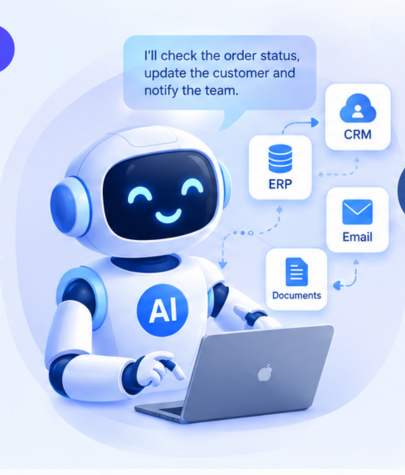
For example, an AI agent handling customer enquiries may identify the customer’s intent, retrieve relevant order information, determine whether the request needs further investigation, and route the case to the appropriate team.
The agent does not simply generate a response. When properly connected to business systems, it can also perform authorized actions to help complete the task.
According to OpenAI’s practical guide to building AI agents, agents can use models, tools, and instructions to manage multi-step tasks. The guide also emphasizes that not every application using AI qualifies as an agent. the official Odoo Barcode documentation.
How Do AI Agents and Traditional Automation Work in Practice?
Consider a business that receives hundreds of customer enquiries through its website, email, and customer support channels.
Scenario 1: Traditional Workflow Automation
A traditional workflow processes each enquiry using predefined conditions.
For example, it can check the selected enquiry category, assign the request to a particular department, send an acknowledgement email, and create a CRM record.
This approach works well when customers provide consistent information and the business rules are clear.
However, a customer may describe a complicated problem that does not fit any predefined category. The workflow may require a fallback rule or manual review.
Scenario 2: AI Agent-Based Processing
An AI agent can interpret the meaning of the enquiry, identify the customer’s likely intent, retrieve relevant information from authorized systems, and recommend or perform the appropriate next action.
For instance, when a customer reports a delayed delivery, the agent may retrieve the order status, review the delivery information, summarize the issue, and prepare a response based on approved company policies.
If the request requires a refund approval or another restricted action, the agent can escalate it to an authorized employee rather than making an unrestricted decision.
Scenario 3: A Hybrid Automation Approach
A hybrid approach combines both technologies.
An AI component interprets the enquiry and determines its category. A conventional workflow then validates the required fields, creates the support ticket, applies routing rules, and records the activity.
This arrangement combines flexible interpretation with predictable execution.
For many businesses, combining AI with traditional automation is a practical starting point because it introduces intelligence without replacing every established process.
When Should Businesses Choose Traditional Workflow Automation?
Traditional workflow automation is often the better choice when a process is stable, repetitive, and easy to describe using explicit business rules.
Consider traditional automation when:
- The same sequence of actions must run consistently for every transaction.
- The input data follows a defined structure.
- Business rules are clear and rarely change.
- The process involves strict validation or precise calculations.
- The cost of an incorrect decision is high and outcomes must remain tightly controlled.
- The workflow does not require complex interpretation or independent planning.
For example, generating an invoice from a verified order, calculating totals, sending payment reminders, and updating inventory after a confirmed sale are generally well suited to rule-based automation.
Adding an AI agent to these tasks may introduce unnecessary complexity if the existing process already works reliably.
Can AI Agents Work With Existing Business Software?
Yes. AI agents can be integrated with existing applications through APIs, supported connectors, and carefully controlled tools. The specific integration depends on the application’s technical capabilities, permissions, and data structure.
For example, an AI agent may retrieve information from a CRM system, summarize an enquiry, and request an update to a customer record. Traditional workflow automation can then perform validation, trigger notifications, and maintain the required business records.
ERP platforms are another possible integration point. Businesses using Odoo may evaluate AI-assisted processes alongside existing inventory, sales, purchasing, or customer support workflows.
Explore Brainwings Infotech’s Odoo development services to learn more about ERP development, customization, and integration possibilities.
Before connecting an agent to production software, businesses should establish which records it can access, which actions it can perform, and which operations require approval.
Why Choose Brainwings Infotech for Odoo Development?
Choosing the right technology partner is essential when implementing AI agents or traditional workflow automation. Businesses need solutions that align with their existing processes, integrate with their software, and support long-term growth.
Brainwings Infotech provides business-focused IT solutions, including custom software development, web and mobile applications, Odoo ERP customization, and system integration. Our goal is to help businesses identify suitable technologies and build solutions around their operational requirements.
Business-Focused Automation Solutions
Every business has different workflows, challenges, and objectives. We focus on understanding your requirements before recommending a suitable technology approach, whether it involves rule-based automation, AI-assisted processes, or a combination of both.
Custom Software Development
Our custom software development capabilities help businesses build applications tailored to their specific operational needs. From workflow improvements to application integrations, solutions can be designed around existing processes and future business goals.
Odoo ERP Customization and Integration
For businesses using Odoo ERP, customized modules and integrations can help streamline processes across sales, inventory, purchasing, and other business functions. Combining established ERP workflows with appropriate AI capabilities may create additional opportunities for efficiency and better information management.
Scalable Web and Mobile Applications
Brainwings Infotech develops web and mobile applications designed around business requirements. These applications can provide a foundation for integrating automation capabilities, connecting business systems, and improving how teams access information.
Quality-Focused Development and Ongoing Support
Successful automation requires more than implementation. Planning, testing, data validation, security controls, and ongoing maintenance are important for reliable business operations. Our development approach includes requirement planning, quality assurance, deployment, and continued support.
Technology Recommendations Aligned With Your Goals
Not every business process requires an AI agent. Some tasks are better handled by traditional automation, while others may benefit from AI-assisted decision-making. We help businesses evaluate their requirements and consider practical solutions based on complexity, integration needs, and business objectives.
Whether you are planning to improve an existing workflow, customize your ERP system, or develop a new business application, Brainwings Infotech can help you explore the right technology approach.
Ready to improve your business processes? Visit Brainwings Infotech or contact our team to discuss your software development and automation requirements.
Final Thoughts
AI agents and traditional workflow automation solve related but different problems. Traditional automation provides dependable execution for predefined business processes, while AI agents introduce greater flexibility for tasks involving context, interpretation, and multi-step decision-making.
The right choice depends on your organization’s requirements, data, budget, integration environment, and risk tolerance. For many businesses, the best solution is not to replace every existing workflow but to combine AI capabilities with reliable business rules and appropriate human oversight.
At Brainwings Infotech, we help businesses explore technology solutions aligned with their operational goals, including custom software development, web applications, and Odoo ERP development and integration.
Looking to improve your business processes with smarter automation? Contact Brainwings Infotech to discuss your requirements and evaluate an approach suited to your business.