Introduction
Getting visitors to a website is an important part of digital marketing, but website traffic alone does not guarantee business growth. A website may receive thousands of visitors every month and still generate very few enquiries, leads, registrations, or sales.
The reason is often related to the website experience. Visitors may struggle to find important information, understand the services offered, navigate the pages, or complete an enquiry form.
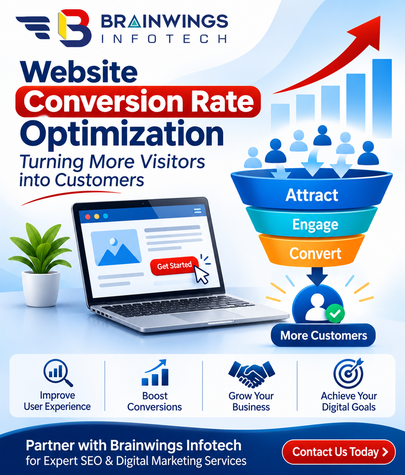
This is where Website Conversion Rate Optimization (CRO) becomes important.
Conversion Rate Optimization is the process of improving a website’s design, content, navigation, landing pages, and user experience to encourage more visitors to take meaningful actions. These actions may include submitting a contact form, requesting a quotation, booking a consultation, signing up for a service, or purchasing a product.
What Is Website Conversion Rate Optimization (CRO)?
Website Conversion Rate Optimization, commonly known as CRO, is a systematic approach to increasing the percentage of website visitors who complete a desired action.
A conversion depends on the business objective. For an IT company, it may be a project enquiry or consultation request. For an e-commerce store, it may be a completed purchase. For a service-based business, it could be a phone call, appointment booking, or quotation request.
The basic conversion rate formula is:
Conversion Rate = (Number of Conversions ÷ Total Visitors) × 100
For example, suppose a business website receives 5,000 visitors in one month and generates 100 completed enquiries.
Conversion Rate = (100 ÷ 5,000) × 100 = 2%
This means 2% of the visitors completed the selected conversion action.
The goal of CRO is to understand why visitors are not taking action and make improvements that help more users complete the desired activity.
It is important to define conversions carefully. A button click, a completed form, and a qualified sales enquiry are different events. Measuring the right outcome helps businesses understand whether website changes are actually contributing to growth.
Why Is Conversion Rate Optimization Important for Businesses?
Businesses invest time and money in search engine optimization, paid advertising, social media marketing, and content creation to attract potential customers.
However, when the website experience is not effective, valuable traffic may leave without taking action.
CRO helps address this challenge in several ways.
1. Make Better Use of Existing Website Traffic
Businesses do not always need more website visitors to improve results. Sometimes, improving the experience for existing visitors can create better opportunities.
For example, simplifying an enquiry form or making contact information easier to find may help more interested visitors submit their details.
2. Generate More Qualified Leads
An effective website communicates the company’s services, target customers, and value proposition clearly.
When visitors understand what a business offers, they can make more informed decisions about whether to enquire.
3. Improve User Experience
Clear navigation, readable content, responsive layouts, and useful calls to action make websites easier to use.
A positive user experience helps visitors find the information they need without unnecessary confusion.
4. Improve Marketing Efficiency
Paid advertising and SEO campaigns bring users to different pages of a website.
If those pages are not designed to support the next step, some of the marketing investment may not produce the expected business outcome.
CRO helps identify and address problems in the visitor journey.
5. Support Business Growth
More completed enquiries or purchases can create additional sales opportunities. However, businesses should focus on conversion quality as well as quantity to ensure that the website attracts the right audience.
10 Effective Website Conversion Rate Optimization Strategies
A successful CRO strategy involves understanding visitor behaviour, identifying website issues, and making improvements based on measurable evidence.
Here are ten practical strategies businesses can implement.
1. Create Clear and Compelling Headlines
The headline is one of the first things visitors notice when they land on a website.
It should explain what the business offers and why the visitor should continue exploring.
Avoid vague headlines that do not communicate a clear benefit.
For example:
- Generic: “Welcome to Our Website”
- More specific: “Custom Software Development Solutions for Growing Businesses”
A strong headline should reflect the visitor’s search intent and match the message of the advertisement, search result, or external link that brought them to the page.
2. Use Strong Calls to Action (CTAs)
A Call to Action guides visitors towards the next step.
Examples include:
- Get a Free Consultation
- Request a Quote
- Contact Our Team
- Book a Meeting
- Explore Our Services
- Start Your Project
CTAs should be easy to understand and placed where visitors naturally need them.
Businesses should also ensure that buttons are clearly visible, mobile-friendly, and connected to the correct destination or action.
3. Simplify Website Navigation
Visitors should be able to find important website information without difficulty.
Complex menus, confusing page structures, and unnecessary navigation options may make users leave before reaching the information they need.
To improve website navigation:
- Use clear menu labels.
- Organize services into relevant categories.
- Provide links to important pages.
- Keep navigation consistent across the website.
- Make contact details easy to access.
- Ensure mobile menus work properly.
A well-organized website helps visitors move smoothly from discovering a business to considering its services.
4. Optimize Landing Pages for Specific Audiences
A landing page should be designed around a particular marketing objective.
For example, a company promoting web development services should direct interested visitors to a relevant web development landing page rather than sending everyone to the homepage.
An effective landing page should include:
- A clear and relevant headline.
- A description of the service or offer.
- Important benefits and features.
- Relevant project examples or testimonials.
- A visible call to action.
- An easy-to-use enquiry form.
- Answers to common customer questions.
Landing page messaging should match the keyword, advertisement, or campaign that brought the visitor to the page.
5. Improve Website Loading Speed
Website performance plays an important role in user experience.
Visitors may become frustrated when pages take too long to load, buttons respond slowly, or important content shifts unexpectedly.
Businesses should pay attention to Google’s Core Web Vitals:
- Largest Contentful Paint (LCP): Measures loading performance. A good target is 2.5 seconds or less.
- Interaction to Next Paint (INP): Measures responsiveness. A good target is below 200 milliseconds.
- Cumulative Layout Shift (CLS): Measures visual stability. A good target is below 0.1.
These metrics help development teams identify performance problems that may affect the browsing experience.
Useful optimization techniques include image compression, efficient coding, caching, reducing unnecessary scripts, and improving server response times.
Performance should be monitored using Google PageSpeed Insights and Google Search Console.
6. Make Your Website Mobile-Friendly
A large proportion of website browsing takes place on mobile devices. A website that works well on desktop but provides a poor mobile experience may lose potential customers.
Mobile conversion optimization should include:
- Responsive page layouts.
- Readable font sizes.
- Properly spaced buttons.
- Easy-to-use navigation.
- Short and accessible enquiry forms.
- Optimized images and media.
- Convenient phone and WhatsApp contact options where relevant.
A consistent experience across desktop, tablets, and smartphones helps visitors interact with the website comfortably.
7. Build Trust Through Social Proof
Visitors may hesitate to contact a company when they are unfamiliar with its reputation or experience.
Trust signals can help reduce uncertainty and provide useful information before a customer makes a decision.
Consider adding:
- Genuine customer testimonials.
- Verified reviews.
- Relevant project portfolios.
- Client success stories.
- Business contact information.
- Company experience and expertise.
- Certifications and relevant professional credentials.
All information should be accurate, verifiable, and presented clearly. Avoid fabricated reviews or unsupported performance claims.
8. Simplify Contact and Enquiry Forms
Long or complicated forms can create unnecessary barriers for users who want to contact a business.
A good enquiry form should collect the information needed for the next step without asking for unnecessary details.
Consider these improvements:
- Request only essential information.
- Use clear field labels.
- Provide helpful validation messages.
- Make the submit button easy to identify.
- Ensure the form works on mobile devices.
- Display a clear confirmation after submission.
- Test the form regularly to prevent submission errors.
For service-based companies, a simple form asking for a name, email, phone number, and project requirement may be sufficient for an initial enquiry.
9. Use High-Quality Visual Content
Visual presentation influences how visitors understand a company’s products and services.
Relevant images, product screenshots, service illustrations, videos, and project demonstrations can make complex information easier to understand.
However, visuals should support the page objective rather than distract visitors.
Businesses should use optimized images, consistent branding, readable typography, and a balanced layout to create a professional website experience.
10. Test Website Changes Before Implementing Them Permanently
CRO should be based on testing and measurable results rather than personal assumptions.
A/B testing allows businesses to compare two versions of a page or element to understand which performs better against a defined objective.
For example, businesses can test:
- Two different headline versions.
- CTA text and button placement.
- Short versus detailed enquiry forms.
- Different landing page layouts.
- Product image arrangements.
- Different trust elements.
Before conducting a test, define the primary metric and ensure the experiment receives enough relevant data. Avoid making decisions based on very small samples or stopping tests as soon as one version appears ahead.
Not every website needs an A/B testing platform immediately. Smaller websites can begin with analytics, user feedback, usability reviews, and carefully monitored changes.
How SEO and Conversion Rate Optimization Work Together
SEO and CRO have different primary objectives, but they complement one another.
Search Engine Optimization (SEO) focuses on improving a website’s visibility in search engines and attracting relevant organic traffic.
Conversion Rate Optimization (CRO) focuses on helping website visitors complete meaningful actions after arriving.
For example, imagine a software development company that ranks for keywords related to custom software development.
SEO can help bring potential customers to its website. However, visitors may leave if the page does not explain its services, demonstrate expertise, or provide a clear way to request a consultation.
CRO helps improve the next steps through better page content, relevant service information, stronger calls to action, and an easier enquiry process.
An effective combined strategy involves:
- Researching relevant keywords and customer search intent.
- Creating useful SEO-focused landing pages.
- Providing clear and relevant service information.
- Improving website navigation and page experience.
- Adding appropriate calls to action.
- Tracking enquiries and other important website actions.
- Reviewing performance and continuously improving pages.
SEO attracts the right audience, while CRO helps make the website more effective at converting that audience.
Important CRO Metrics Every Business Should Track
Measuring website performance helps businesses identify opportunities for improvement.
Rather than tracking only website visits, companies should monitor metrics related to engagement, enquiries, and revenue.
1. Conversion Rate
Measures the percentage of users or visitors completing a defined action.
It helps businesses understand how effectively a website or landing page supports its primary objective.
2. Landing Page Performance
Review how individual landing pages perform in terms of traffic, engagement, and completed actions.
This helps identify pages that attract visitors but generate fewer enquiries.
3. Form Submission Rate
Measures the number of successful form submissions in relation to relevant form views or visits.
It can help reveal whether forms are easy to understand and complete.
4. Bounce and Engagement Behaviour
Review how visitors interact with website content, which pages they explore, and where they leave the website.
In GA4, engagement metrics and journey analysis can provide more useful context than relying on a single bounce metric.
5. Cost Per Lead
For businesses running paid marketing campaigns, cost per lead helps evaluate how much is spent to generate an enquiry.
However, lead quality should also be considered when assessing campaign performance.
6. Lead Quality and Sales Outcomes
Not every enquiry becomes a customer.
Businesses should connect website analytics with CRM or sales records where possible to understand which channels and landing pages generate qualified leads and actual business opportunities..
Common Website CRO Mistakes Businesses Should Avoid
Even websites with attractive designs and strong traffic can experience conversion problems when important details are overlooked.
Here are some common mistakes:
1. Focusing Only on Website Traffic: More visitors do not automatically mean more qualified leads or sales.
2. Using Unclear CTAs: Visitors may not understand what action they should take next.
3. Ignoring Mobile Users: Difficult navigation and poorly designed forms can create unnecessary friction.
4. Adding Too Many Form Fields: Unnecessary questions may discourage interested visitors.
5. Ignoring Website Performance: Slow pages and unresponsive elements can affect user experience.
6. Using Generic Landing Pages: A landing page that does not match the visitor’s intent may fail to communicate relevant information.
7. Making Changes Without Measurement: Design preferences alone cannot establish whether a website improvement is effective.
8. Tracking the Wrong Conversions: Counting button clicks as successful leads can give businesses an inaccurate picture of results.
Avoiding these mistakes creates a stronger foundation for continuous website optimization.
How Brainwings Infotech Can Help Improve Website Conversions
A conversion-focused website requires more than attractive design. It needs a combination of technical performance, SEO strategy, user-friendly navigation, relevant content, and effective digital marketing.
Brainwings Infotech provides digital services that can help businesses improve their online presence and develop websites aligned with their business goals.
1. SEO Services
Our SEO services focus on keyword research, on-page optimization, technical SEO, content strategy, and off-page optimization.
A well-planned SEO strategy helps businesses attract relevant organic visitors who are more likely to be interested in their products or services.
Explore our SEO Services.
2. Digital Marketing Services
Digital marketing helps businesses reach their target audiences through relevant online channels.
A focused marketing strategy can connect campaigns with suitable landing pages, improve audience targeting, and help businesses evaluate campaign performance.
Explore our Digital Marketing Services.
3. Professional Web Design
Website design influences how visitors understand a brand and interact with its content.
Brainwings Infotech provides web design solutions focused on attractive layouts, usability, and business requirements.
Explore our Web Design Services.
4. Responsive Web Design
A responsive website adapts its layout to different screen sizes and devices.
Mobile-friendly navigation, readable content, and accessible interaction elements help provide a consistent experience across smartphones, tablets, and desktops.
Explore our Responsive Web Design Services.
5. E-Commerce Development
For online businesses, the shopping experience plays an important role in conversion performance.
Brainwings Infotech provides e-commerce development solutions designed around user-friendly shopping experiences, responsive layouts, payment integration, and scalable store functionality.
Explore our E-Commerce Development Services.
Final Thoughts
Website Conversion Rate Optimization is an important part of a successful digital marketing strategy. Attracting visitors is only the beginning. Businesses also need to create a website experience that makes it easy for users to understand their offerings, build trust, and take meaningful action.
From improving landing pages and website speed to simplifying enquiry forms and tracking user behaviour, every improvement should support a clear business objective.
Combining SEO, responsive web design, digital marketing, and CRO can help organizations build a stronger digital presence and make better use of their website traffic.
At Brainwings Infotech, we help businesses strengthen their online presence through professional web design, website development, SEO, and digital marketing solutions.
Ready to make your website more effective?
Contact Brainwings Infotech to discuss your website, SEO, and digital growth requirements.
Website: https://brainwingsinfotech.com/
Email: info@brainwingsinfotech.com
Phone: +91 76218 77140