Introduction
Online shopping has changed significantly. Customers now expect online stores to load quickly, work smoothly on mobile devices, provide personalized experiences, and make purchasing simple.
For businesses, meeting these expectations can become difficult when an eCommerce website depends heavily on a traditional platform and its built-in frontend.
This is where headless e-commerce development can provide a different approach.
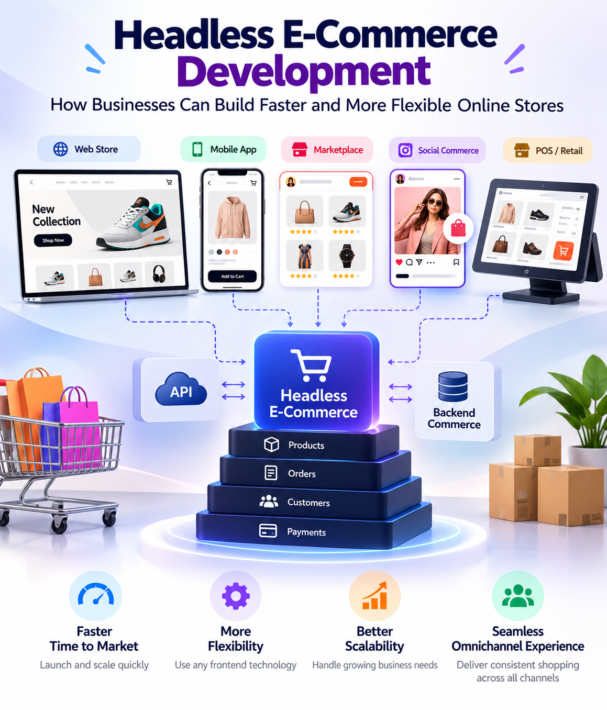
A headless eCommerce architecture separates the customer-facing frontend from the backend commerce system. This gives businesses greater flexibility to create unique shopping experiences while keeping the core commerce functions connected through APIs.
What Is Headless E-Commerce?
Headless eCommerce is an approach where the frontend presentation layer of an online store is separated from the backend commerce system.
In a traditional eCommerce website, the frontend and backend are closely connected. The platform generally controls how products, categories, shopping carts, checkout pages, and other elements are displayed.
In a headless architecture, the frontend can be developed separately using modern technologies while the backend manages core commerce functions.
APIs connect the two systems.
This means a business can use a powerful commerce backend while creating a completely customized customer experience on the frontend.
How Does Headless E-Commerce Work?
A simple headless eCommerce architecture usually includes three major components:
1. Frontend
The frontend is what customers see and interact with.
It can be developed using modern technologies such as:
- React.js
- Next.js
- Vue.js
- Angular
- Other modern frontend frameworks
The frontend manages elements such as product pages, navigation, search, product filters, shopping experiences, and content presentation.
2. Commerce Backend
The backend manages core eCommerce operations, including:
- Products
- Product categories
- Pricing
- Customers
- Orders
- Inventory
- Shopping carts
- Payments
- Promotions
The backend can be an existing eCommerce platform or a customized commerce system.
3. APIs
APIs act as the communication layer between the frontend and backend.
When a customer views a product, adds an item to the cart, or places an order, the frontend communicates with the backend through APIs.
This separation gives developers more freedom to create and improve the customer-facing experience. brings many of these processes into a connected environment. Instead of managing every company completely independently, organizations can establish common processes while maintaining company-specific data and rules.
Traditional E-Commerce vs Headless E-Commerce
he main difference is the relationship between the frontend and backend.
Traditional E-Commerce
In a traditional setup:
Frontend + Backend = Closely Connected System
Changing the frontend may require working within the limitations of the selected platform.
Headless E-Commerce
In a headless setup:
Frontend + API + Backend = Separate but Connected Systems
Developers can change or rebuild the frontend without completely replacing the commerce backend.
This can be particularly useful for businesses that want to create unique shopping experiences or support multiple digital channels.
Why Are Businesses Considering Headless E-Commerce?
Businesses are becoming more focused on website performance, customer experience, personalization, and scalability.
A traditional eCommerce solution may be sufficient for a small or straightforward online store.
However, growing businesses may need:
- Highly customized user experiences
- Faster frontend performance
- Multiple sales channels
- Custom integrations
- Flexible technology choices
- Personalized shopping journeys
- Better control over the frontend
- Scalable digital architecture
Headless eCommerce can help address these requirements.
Key Benefits of Headless E-Commerce Development
C1. Faster and More Flexible Frontend
A headless approach gives developers greater control over the frontend.
Modern frameworks can be used to create fast and optimized experiences tailored to the business.
For example, a business can build its storefront using Next.js or React.js while keeping the existing commerce backend.
2. Better User Experience
Customer expectations are high.
Visitors want product pages to load quickly, navigation to be simple, and the purchasing process to feel smooth.
Because the frontend can be designed independently, businesses can create experiences specifically for their customers rather than being restricted by a fixed storefront structure.
3. Greater Design Freedom
Traditional eCommerce platforms can sometimes limit how much a business can change its storefront.
With headless eCommerce development, designers and developers have much greater control over the presentation layer.
Businesses can create:
- Custom product pages
- Interactive shopping experiences
- Unique landing pages
- Personalized interfaces
- Custom navigation
- Advanced product filtering
This can help brands create an online store that looks and feels different from competitors.
4. Easier Multi-Channel Experiences
Customers do not always shop through a traditional website.
They may interact with a brand through:
- Mobile applications
- Websites
- Smart devices
- Social platforms
- Marketplaces
- Digital displays
- Other connected channels
A headless architecture can make it easier to deliver commerce functionality to different frontends using APIs.
The same backend commerce data can potentially support multiple customer-facing experiences.
5. Improved Scalability
As a business grows, its eCommerce requirements can become more complex.
A headless architecture can provide greater flexibility when adding new features, channels, integrations, or frontend experiences.
Businesses can evolve individual parts of their technology stack without necessarily rebuilding the entire commerce system.
6. Easier Technology Changes
Technology continues to change.
A business may want to replace its frontend framework in the future while continuing to use its existing commerce backend.
Because the frontend and backend are separated, technology changes can be more manageable when the architecture is properly designed.
7. Better Integration Opportunities
Modern businesses often use multiple systems.
An online store may need to connect with:
- CRM software
- ERP systems
- Payment gateways
- Marketing platforms
- Inventory systems
- Shipping providers
- Customer support tools
- Analytics platforms
A headless architecture can make API-based integrations an important part of the overall system design.
How Brainwings Infotech Can Help With Headless E-Commerce Development
Brainwings Infotech provides eCommerce development services focused on creating scalable, responsive, user-friendly online stores. The company’s service portfolio includes eCommerce development along with Shopify, Magento, PrestaShop, Next.js, React.js, Vue.js, and other web development technologies.
For businesses considering a headless architecture, Brainwings Infotech can help with areas such as:
- Custom eCommerce website development
- Frontend development
- API integration
- Shopify development
- Magento development
- Next.js development
- React.js development
- Vue.js development
- Payment integration
- Third-party integrations
- Responsive eCommerce development
- Performance optimization
- Ongoing website support
The development process can begin with understanding the business requirements and selecting an architecture that matches the store’s current needs and future growth plans. Brainwings Infotech’s existing eCommerce development process also emphasizes understanding the business, planning, development, testing, launch, and ongoing support.
Final Thoughts
Headless e-commerce development gives businesses a modern way to build flexible, scalable, and highly customized online stores.
By separating the frontend from the commerce backend, businesses can gain greater control over design, performance, customer experience, integrations, and future technology changes.
However, headless eCommerce is not automatically the best solution for every business. The decision should be based on the store’s requirements, budget, technical capabilities, customer expectations, and long-term growth strategy.
If your business needs a fast, flexible, and customized online store, a well-planned headless eCommerce architecture can provide a strong foundation for future growth.
Brainwings Infotech can help businesses plan, develop, integrate, and optimize modern eCommerce solutions based on their specific business requirements.