Introduction
Manufacturing businesses need to manage multiple activities simultaneously, including raw material procurement, inventory management, production scheduling, work order execution, and finished goods delivery. When these activities are handled through disconnected spreadsheets or separate software systems, businesses may experience material shortages, production delays, inaccurate costing, and limited visibility into shop-floor operations.
Odoo Manufacturing MRP helps businesses organise these processes within an integrated ERP environment. It connects manufacturing activities with inventory, purchasing, sales, and other business functions, helping teams plan production requirements and track manufacturing operations more effectively.
What Is Odoo Manufacturing MRP?
MRP, commonly used to mean Material Requirements Planning, helps businesses determine which materials are needed, how much is required, and when those materials must be available for production.
Odoo Manufacturing extends this planning process into manufacturing operations. It allows businesses to define product components, prepare manufacturing orders, organise work orders, manage work centres, monitor production progress, and analyse manufacturing performance.
The Manufacturing module works alongside Odoo’s Inventory and Purchase applications, helping businesses coordinate material availability with their production plans. Depending on the configuration, it can also connect with Sales, Accounting, Quality, Maintenance, and other applications.
For example, when a business receives an order for 500 finished products, its production team needs to understand the component requirements, material availability, production steps, and expected manufacturing duration. Odoo provides tools to organise and monitor these requirements through a connected workflow.
Why Do Manufacturers Need an MRP System?
Manufacturing operations become difficult to manage when production planning depends on manual calculations, outdated spreadsheets, or information shared across different departments.
Common challenges include:
- Raw material shortages: Production cannot proceed because essential components are unavailable.
- Unplanned production schedules: Orders compete for machine capacity, labour, and production time.
- Limited production visibility: Managers cannot easily determine which manufacturing orders are pending, in progress, or completed.
- Inconsistent cost estimates: Actual material consumption or production time differs from the original estimates.
- Excess inventory: Businesses purchase or manufacture more than they currently need.
- Delayed customer orders: Poor coordination between demand, production, and inventory affects delivery commitments.
An integrated MRP system helps organise these activities around shared operational data. Although software cannot eliminate every production issue, it gives teams better information for planning, monitoring, and corrective action.
Key Features of Odoo Manufacturing MRP
1. Bill of Materials (BoM) Management
A Bill of Materials defines the components, quantities, and, where required, operations needed to manufacture a product.
Odoo allows manufacturers to create BoMs for individual products, manage product variants, and define production operations. Multilevel BoMs can represent products assembled from subcomponents that have their own manufacturing requirements.
For example, a furniture manufacturer may need timber, screws, handles, hinges, and finishing materials to produce a cabinet. A properly configured BoM records these requirements so production teams can understand the components needed for each manufacturing order.
Business value: Standardised component definitions support more consistent material planning and production execution.
2. Manufacturing Orders and Work Orders
Manufacturing orders record what product needs to be manufactured and in what quantity. Work orders can break the manufacturing process into individual operations assigned to appropriate work centres.
A production process might include cutting, machining, assembly, finishing, and final packing. By organising these activities as work orders, businesses can monitor progress across the production cycle.
Teams can also record production quantities and track the time spent on operations, depending on the configured workflow.
Business value: Clearer task allocation helps production managers coordinate activities and identify unfinished operations.
3. Production Planning and Scheduling
Manufacturers must balance customer demand with the availability of materials, machines, employees, and production capacity.
Odoo provides manufacturing planning tools, including the Master Production Schedule, to help businesses review forecasted demand and plan replenishment for selected products. Work-centre planning and work-order scheduling can also help teams organise production activities.
Planning should reflect actual operational constraints. Businesses need to configure their work centres, working calendars, lead times, and production processes accurately to make schedules useful.
Business value: Better planning can help reduce avoidable scheduling conflicts and support more reliable production commitments.
4. Raw Material and Inventory Coordination
Production depends on having the right components available at the right time. Manufacturing requirements must therefore be coordinated with inventory levels and purchasing activities.
Odoo integrates manufacturing workflows with inventory operations, helping businesses track component consumption and finished product quantities. Depending on the configured warehouse workflow, component picking and finished-product storage can be managed through one-step, two-step, or three-step manufacturing processes.
When additional materials are required, the wider Odoo inventory and purchasing workflows can help teams organise replenishment.
Business value: Improved coordination helps businesses identify material requirements earlier and manage stock more effectively.
5. Shop-Floor Operations and Work-Centre Tracking
Production managers need visibility into the actual work being performed on the factory floor. Odoo’s Shop Floor interface supports the execution of work orders and provides operational information to workers at their work centres.
Depending on the setup, teams can start and complete work orders, record production activity, and track operation durations.
Work-centre configuration is particularly valuable for manufacturers with multiple production stages or machines. It helps connect planned operations with their execution on the shop floor.
Business value: More accessible production information helps supervisors monitor progress and identify operational delays.
6. Manufacturing Cost Analysis
Understanding production costs is essential for pricing, budgeting, and profitability analysis.
Odoo can calculate estimated manufacturing order costs using configured component and operation costs. Actual costs can differ because of changes in component consumption, operation duration, or other production factors.
Manufacturers can use production analysis reports to examine measures such as component costs, operation costs, production quantities, manufacturing duration, and average production cost.
Accurate analysis depends on maintaining reliable product costs, BoMs, work-centre rates, and production records.
Business value: Better cost visibility helps businesses investigate cost differences and make informed operational decisions.
7. Lot and Serial Number Traceability
Manufacturers in industries such as electronics, machinery, automotive components, and specialised equipment may need to identify individual products or production batches.
Odoo supports lot and serial number tracking for configured products. This allows businesses to associate manufactured quantities with identifiable lots or individual units, according to their traceability requirements.
Traceability processes should be designed around the company’s industry, customer requirements, and applicable regulations.
Business value: More structured product identification supports traceability, inventory control, and investigation of production-related issues.
How Does Odoo Manufacturing MRP Work?
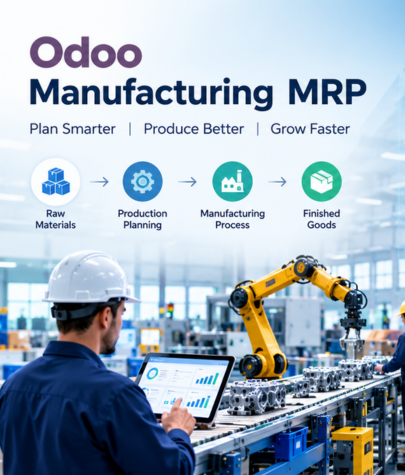
A typical manufacturing workflow can follow these steps.
Step 1: Define the product and its requirements
Create the finished product in Odoo and configure its Bill of Materials with the required components and quantities. Add production operations where necessary.
Step 2: Review production demand
Use sales requirements, replenishment needs, and production forecasts to determine which products need to be manufactured.
Step 3: Check material availability
Review stock levels and component requirements. Identify materials that need to be purchased, replenished, or transferred before production can proceed.
Step 4: Create and plan manufacturing orders
Create manufacturing orders for the products and quantities required. Assign the relevant BoMs and plan the necessary work orders according to the configured production process.
Step 5: Execute production
Workers complete the required operations, record progress, and register production according to the manufacturing workflow.
Step 6: Update inventory and review results
Once production is recorded, manufactured quantities and component consumption update the relevant inventory records. Managers can then review production quantities, durations, costs, and operational performance through available reports.
This connected workflow helps manufacturing, inventory, and purchasing teams work with consistent operational information.
Practical Example: Odoo MRP for a Furniture Manufacturer
Consider a furniture manufacturer that receives an order to produce 200 office desks.
The production team first defines the desk’s Bill of Materials, including wooden panels, metal frames, screws, and finishing materials. The team then checks whether the required components are available in inventory.
After reviewing the material requirements, the production manager prepares manufacturing orders and organises the necessary operations, such as cutting, drilling, assembly, polishing, and packing.
As the work progresses, operators record completed work orders and production quantities. Once the desks are manufactured, the business updates its finished-product inventory and reviews the actual production costs and operation durations.
With the right configuration and reliable data, Odoo helps the company coordinate its materials, work orders, and manufacturing records within a connected system rather than relying on disconnected spreadsheets.
Is Odoo Manufacturing MRP Suitable for Your Business?
Odoo Manufacturing MRP can be useful for small and medium-sized manufacturers as well as larger businesses that need better coordination between production and other departments.
It may be worth evaluating when your business:
- Manufactures products using defined components and production steps.
- Needs to coordinate raw material availability with production demand.
- Manages multiple work centres or manufacturing stages.
- Wants to improve manufacturing cost visibility.
- Requires connected inventory and production records.
- Needs an ERP workflow that can adapt as operations grow.
Businesses with highly specialised machinery, complex production constraints, industry-specific traceability, or unusual costing requirements should assess these needs carefully during implementation planning. Additional configuration, integrations, or custom development may be necessary.
Why Choose Brainwings Infotech for Odoo Manufacturing Solutions?
Implementing manufacturing software requires more than installing an application. It involves understanding production workflows, configuring business rules, connecting related systems, and ensuring that employees can use the solution effectively.
Brainwings Infotech provides Odoo ERP development, implementation, customisation, integration, migration, and support services to help businesses adapt Odoo to their operational requirements.
For manufacturing businesses, the implementation approach should begin with a review of production processes, inventory practices, reporting needs, and integration requirements. The resulting solution can then be configured around the company’s priorities, with custom development introduced where appropriate.
Explore our Odoo Development and ERP Services to discuss a solution aligned with your business requirements.
Final Thoughts
Odoo Manufacturing MRP helps manufacturers bring production planning, material requirements, work orders, inventory coordination, and manufacturing cost analysis into a connected ERP workflow.
By maintaining accurate Bills of Materials, organising work-centre operations, monitoring material availability, and reviewing production data, businesses can make better-informed decisions throughout the manufacturing cycle.
Successful implementation starts with understanding existing processes and configuring Odoo around real operational needs. With the right planning, training, and ongoing improvements, manufacturers can build a more organised and scalable production management system.